Progressive Autonomy: A third option for AI in customer support
Why forcing teams to choose between "autonomous resolution" and "agent co-pilot" gets the deployment problem wrong — and what we've built instead

The AI-in-support category has split into two camps.
One camp sells autonomous resolution. Fin, Salesforce Agentforce, Zendesk Forethought — turn the AI on, let it resolve tickets end-to-end, pay per resolution. The pitch: AI can handle your tickets, so let it. Trust the model, or don't use it.
The other camp sells the co-pilot. Zendesk's copilot, most native platform AI — the AI drafts replies, summarizes threads, suggests knowledge articles, pay per user. Your agents work faster. The pitch: augment your team, keep humans in charge.
Both are defensible. Neither fits how mid-market support teams actually adopt AI.
Talk to enough support leaders and the pattern becomes obvious: teams want both. They want the co-pilot on the tickets that need judgment. They want resolution on the tickets that are routine — account queries, how-tos, refund policies — that are eating agent time for no good reason. And they want to earn their way from one to the other on a timeline they control, not by flipping a switch and hoping the AI performs.
Nobody was building that. So we did.
What progressive autonomy actually means
Flexivity operates at seven levels of automation on every ticket. You decide the level per class of tickets.
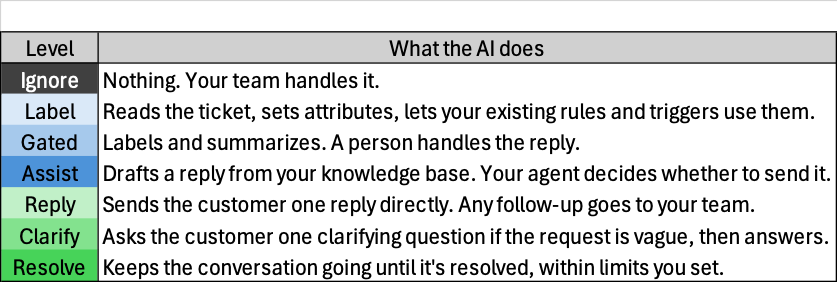
Every ticket starts at Assist. When you trust the AI on a class of tickets — say, "how-to" queries — you promote that class to Reply or Resolve. Sensitive or complex tickets (a refund dispute, a churned customer) stay at Assist as long as you want.
Rules match on ticket attributes and choose the level. Topic is billing → Assist. Topic is order status → Reply. Sentiment is frustrated → Gated. Each rule is a setting in the admin console. No project, no re-deployment, no vendor engagement to change the boundary.
This is the mechanism that makes "trust the AI incrementally" real instead of aspirational.
Why the two camps miss this
The autonomous resolution camp treats deployment as binary. AI on, humans off. That works at enterprise scale where the AI vendor's implementation team can pre-tune everything for six months before go-live. It doesn't work for a mid-market team that needs to be operational in a week and can't spend enterprise budget on a vendor's professional services.
The co-pilot camp treats automation as suspicious. Every ticket gets a human in the loop, forever, even when the AI would handle it perfectly and the customer would be better served by a faster answer. That leaves real efficiency on the table.
Progressive autonomy sits between the two, but not as a compromise. It's a different model of the deployment problem: trust is earned per class of tickets, and the product's job is to let teams promote a class up the ladder as their confidence grows.
Grounded, controlled, and honest about what it doesn't know
The other reason the autonomous resolution camp underperforms in practice: it assumes the AI's answer is right. In real deployments, models confidently give wrong answers when the underlying knowledge base is incomplete, out of date, or fragmented across systems.
Flexivity grounds every answer in your knowledge base, with each claim tied to the article it came from. This attribution step runs on every reply. Additionally, we provide optional entailment claim verification — if the AI can't verify an answer against a source article, the reply is withheld and the ticket goes to an agent with the reason stated. A single switch stops all AI replies to customers instantly.
The AI is also honest about its gaps. When your knowledge base doesn't cover a question, the ticket escalates to a person and the gap is flagged for the Knowledge Builder to address. Every gap that gets filled means fewer tickets to work.
Agent co-pilot, still foundational
Progressive autonomy doesn't diminish the co-pilot — it makes it better.
When a ticket reaches an agent, the Flexivity panel is already populated: summary, sentiment, matching knowledge articles, related past tickets, and a drafted reply. Agents work in the same ticket view they already use — no new tool, no extra login, no context to rebuild.
The co-pilot is where every deployment starts. It's also where most tickets stay, and where the AI adds compounding value: every ticket the AI works on informs the knowledge base, every agent correction refines the classification, every rating on a summary or draft feeds the analytics that show where to tune.
What this means for you
For support leaders evaluating AI right now: you shouldn't have to pick between autonomous resolution you can't control and a co-pilot that can't grow into resolution when you're ready. Progressive autonomy is the third option. You start at assist, you promote when you're ready, and you keep the boundary where you want it.
Flexivity is available today for Zendesk and osTicket, with Freshdesk coming. Pricing is $0.25 per conversation pay-as-you-go — $0.15 per conversation promotional launch pricing with annual commit. One flat price whether the AI drafted, replied, or resolved, with no per-agent seat fees and no per-resolution surprises.
If you're a mid-market support team ready to explore this — particularly on Zendesk or osTicket — we're taking on a small number of design partners at launch. Three months free, 20% off locked for two years, and a real voice in shaping where the product goes. Or just start a free trial, there's no credit card required.
Book a Demo - https://flexivity.ai/book-a-demo
See Pricing - https://flexivity.ai/pricing
Over the next few weeks, we'll dig deeper on each of the three pillars of Flexivity: progressive autonomy in more depth, how the agent co-pilot builds and uses context, and how the Knowledge Builder closes the KB gaps that quietly cap every AI deployment. Follow along if this is a category you're thinking about.